
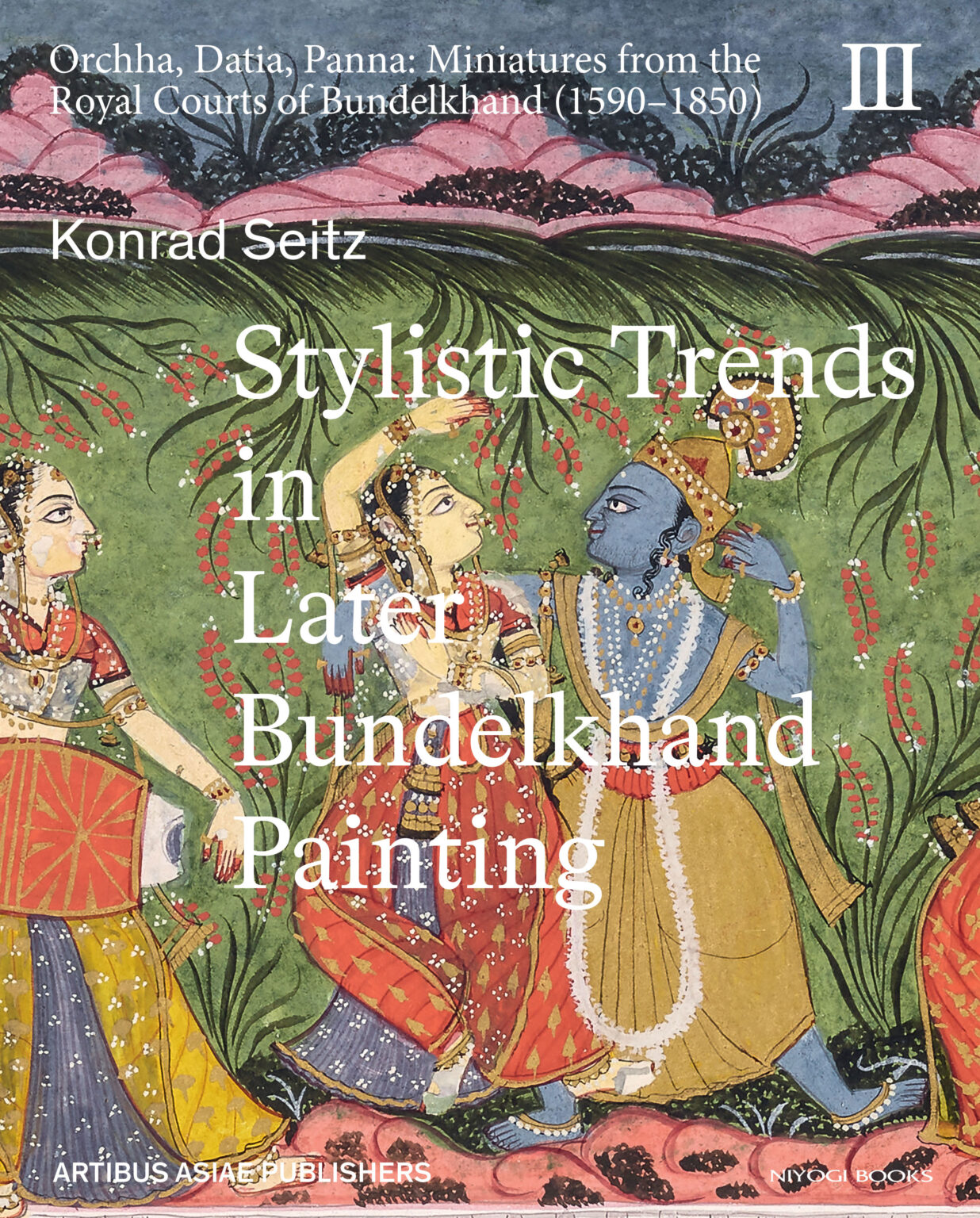

Stylistic Trends in Later Bundelkhand Painting
Original price was: ₹4,500.00.₹4,495.00Current price is: ₹4,495.00.
The third and final volume of Konrad Seitz’s acclaimed series on Bundelkhand miniature painting, exploring the artistic traditions of Datia and Panna from 1635 to 1840. Featuring more than 90 paintings, this illustrated study examines Mughal influences, regional styles and the nineteenth-century revival of Bundelkhand painting.
| Author |
Konrad Seitz |
|---|---|
| ISBN |
9788119626717 |
| Year Of Publication |
2024 |
| Pages |
246 |
| Language |
English |
| Binding |
hardcover |
| Publisher |
Niyogi Books |
ISBN: 9788119626717
Year Of Publication:2024
Pages : 246
Language : English
Binding : hardcover
Publisher: Niyogi Books
This volume focuses on the later phases of Bundelkhand painting, covering three important historical periods:
-
Datia (1635–1675): The emergence of Mughal-influenced painting after the decline of Orchha as the principal Bundela centre.
-
Panna (1675–1731): The development of painting under Raja Chhatrasal and the establishment of his kingdom.
-
Datia (1800–1840): The revival of court painting during the period of British suzerainty, influenced by the Mughal-Rajput artistic tradition.
Konrad Seitz was a distinguished German diplomat, historian, author and collector of Indian miniature paintings. He lived in India for many years and served as the German Ambassador to India from 1987 to 1990.
Along with his wife, Eva Seitz, he assembled an important private collection of Indian miniature paintings, particularly works associated with the royal courts of Bundelkhand.
His research focused on the history, development and stylistic characteristics of Indian miniature painting. Through his publications and contributions to museum collections, he helped make important examples of Bundelkhand painting accessible to scholars and art enthusiasts internationally.
Stylistic Trends in Later Bundelkhand Painting traces the transformation of miniature painting in Bundelkhand after the early Orchha period.
The first major section examines Datia between 1635 and 1675. Following the disintegration of Orchha, Datia emerged as an independent principality and a significant centre of artistic activity. Its painters increasingly adopted Mughal-influenced techniques, creating a distinctive style that combined imperial artistic conventions with regional characteristics.




Reviews
There are no reviews yet.